
Adhesive Backed Materials Ltd
Custom Gaskets, Die Cut to Your Specification
Sealing · EMI/EMC Shielding · Thermal · Composite · Acoustic

We are a UK gasket converter. We cut gaskets from technical materials (foams, rubbers, felts, films, and conductive and thermal materials) rather than machining them from metal.
Most of our customers arrive with the material already specified: a drawing, a part number, or an existing gasket that needs reproducing.
Our job is to convert it accurately and repeatably: the right process for the volume, clean edges, held tolerances, and a part that drops straight into your assembly.
Everything happens under one roof in South Wales. Laminated, cut, slit and finished in a single flow, with full traceability from roll stock to finished part.
Send us a drawing or a sample and we will quote.
Sealing Gaskets
Sealing gaskets keep out air, dust, water, oil and chemicals. They are the most common gasket we cut and the one with the widest material choice.
Soft open-cell foams suit light closure forces and dust sealing.
Closed-cell foams and sponge rubbers seal against moisture and weather.
Solid elastomers handle higher compressive loads, chemical attack and temperature extremes.
Choosing between them is largely about the environment. For example, Neoprene is often specified for outdoor sealing, when EPDM will usually weather better. Neoprene's real advantage is oil resistance.
We cut all of them, with or without adhesive backing, from single prototypes through to production volumes.

EMI and EMC Shielding Gaskets
A shielded enclosure only works if it is electrically continuous.
Radio-frequency currents flowing over its surface need an unbroken path, and every joint between two panels interrupts that path. Paint, anodising and ordinary surface roughness mean the two faces touch only at scattered high spots.
The gap left between them behaves like a slot antenna and leaks.
A shielding gasket is a compressible conductive material that fills that gap and makes contact along the full length of the seam, so current flows across the joint instead of radiating from it.
Which material suits a given joint depends mainly on how much closure force is available.
Conductive foams and fabric-over-foam suit lightly clamped joints (enclosure lids, hinged panels, board-level shields) where the gasket must compress under modest force and the requirement is shielding alone.
Where the joint has to shield and seal against moisture, dust or fluids, the usual answer is a conductive elastomer: a filled silicone or fluorosilicone that conducts through its full cross-section while behaving as a solid environmental seal, which a faced foam construction cannot do.
Conductive copper, aluminium and fabric tapes handle seam shielding and ground paths.
If your drawing already names a grade, send it. We convert Würth Elektronik EMC materials routinely, including WE-LS conductive foam and WE-FAS flexible absorbers, alongside conductive fabrics, foils and tapes from other suppliers. Where no grade is specified, tell us what the joint has to do and how much closure force is available, and we will suggest a family for you to evaluate.
Prototype quantities can be cut on the CNC tables with no tooling cost, so you can prove the geometry before committing to a die.


Thermal Interface Gaskets
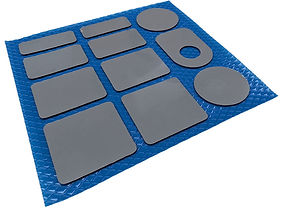
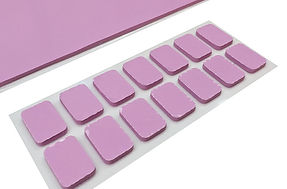
Thermal gaskets move heat from a component into a heatsink or chassis while taking up the tolerance gap between the two.
Gap pads, gap fillers, phase-change materials and combined thermal-EMI absorbers are all supplied in sheet form, and all of them need cutting to a footprint before they can be fitted.
These materials are soft, frequently tacky on both faces, and easily distorted. Cutting them cleanly, including internal apertures and free-form outlines, is a converting problem in its own right, and it is one we handle routinely.
Gap fillers and gap pads we convert regularly include Würth Elektronik's WE-TGF range, alongside equivalent grades from other manufacturers.
Send us the dimensions and the grade and we will cut it.


Electrical Insulation Gaskets
Insulation gaskets and barriers keep conductive parts apart while still fitting the geometry of the assembly.
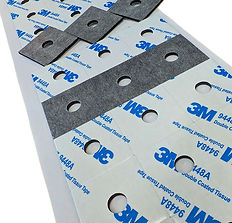
Typical work includes busbar insulators, slot liners and phase barriers for motors and transformers, cell isolation barriers in battery packs, terminal insulators, enclosure barriers and insulating washers.
We hold and convert polyester films (Mylar A and Melinex), polypropylene and polycarbonate (Lexan). Polyimide film (Kapton) we cut to order.
Kapton is worth a word on its own. Board and blade tooling has a join wherever the steel rule closes, and at that join the cutting edge is not quite continuous. Polyimide is tough enough to survive it. Instead of severing, the film snags, and on a kiss cut part that means it holds onto the waste web at the snag point rather than stripping cleanly.
Cutting Kapton properly needs forged steel tooling or a forged rotary tool, machined from solid so the cutting edge runs continuously with no join. If your part is in Kapton, tell us early, because it changes the tooling and with it the price and the lead time.
Board and blade tooling can also leave a light witness mark or snag where the rule joins. This can happen at any gauge, on functional parts it is normally negligible, but negligible is a judgement, and yours may not match ours.
So if edge appearance matters on your part, tell us at enquiry stage. We can cut on the CNC knife tables, which have no tool joins at all, or use forged tooling. On any part where the edge is critical we will send a first-off for your approval before running production, so you are judging the actual edge rather than our description of it.
Cut edge quality matters more here than on almost any other gasket. A burr, a cracked film edge or a delaminated laminate shortens the effective path between conductors, so how a part is cut affects how it performs. We convert these materials regularly and set the process accordingly.
Dielectric ratings, creepage and clearance distances are for your design team to set. Send us the drawing and the grade and we will cut to it, and we would always recommend validating the finished part before production.


Acoustic and Anti-Vibration Gaskets
Open-cell foams, felts and needle-punched non-wovens absorb airborne noise and dampen structure-borne vibration.
We cut these into gaskets and pads for enclosure panels, access covers and mounting interfaces.
Adhesive backing is applied before cutting where the part needs to be fitted quickly on an assembly line, and a flocked or fabric facing can be laminated to the show face where the part is visible.


Composite and Multi-Layer Gaskets
When no single material meets every requirement, the answer is usually a composite: two or more materials bonded into one construction.
Our lamination line bonds adhesives, carriers and functional layers up to 30 mm thick, single or double sided. Our cutting equipment then converts the laminated material into a finished part.
Typical builds include a foam core with a polyester carrier for dimensional stability during automated assembly, a flocked face for low-friction or anti-scratch contact, or an adhesive layer applied before cutting so the part arrives ready to fit.
If your drawing calls for a laminated construction, we can build it here rather than sub-contracting the lamination and re-handling the material.


Choosing the Right Process for Your Gasket
The right cutting process depends on quantity, complexity and how the part will be applied. We run all of them in-house, so the choice is made on what suits your part rather than what suits our equipment.
CNC Knife Cutting (prototypes and short runs)
Digital tooling means no steel die to commission. Send a revised CAD file and the next part is different, which suits prototypes, evolving specifications and large-format gaskets. Our 3 m × 2 m bed also handles gaskets far too large for a press.
Die Cutting (established parts in volume)
Once a gasket design is settled, flatbed die cutting delivers the speed and repeatability that production volumes need. Board-and-blade tooling keeps the tooling cost proportionate for most applications.
Kiss Cutting (self-adhesive gaskets on a roll)
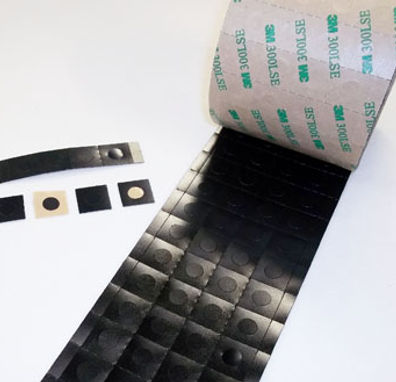
Kiss cutting cuts through the gasket and its adhesive but leaves the release liner intact, so parts arrive on a roll ready to peel and apply. We can add a pull tab to the liner, a small feature that makes a real difference when parts are applied by hand in volume
Full specifications for every process are on our precision converting capabilities page
Gasket Sizes and Specifications
Maximum part size:
2,900 mm × 1,900 mm (CNC knife cutting)
Maximum material thickness:
100 mm (CNC), 7 mm (kiss cutting)
Minimum feature size:
Depends on material, thickness and cutting method. Send a drawing and we will advise.
Roll-form gaskets:
Slit widths from 4 mm wide
Adhesive backing:
One or both faces, applied in-house
Tooling:
Digital (no cost) or board-and-blade / forged steel
Quantities:
No minimum. Single prototypes through to production volumes
Getting a Gasket Quoted
Any of the following is enough for us to quote:
-
A CAD file: DXF or DWG goes straight to the cutting table -
A dimensioned drawing: hand-drawn is fine, provided the critical dimensions are on it -
A sample: send the existing gasket, even a worn one, and we will measure and reproduce it
Please tell us the material or grade if you know it, the quantity you need, and whether the part requires adhesive backing.
If you are not certain which grade to use, tell us what the part has to do and where it will be working. We can usually point you toward the right family, though we are converters rather than design engineers, and we will always ask you to validate a material by testing before you commit to production.
One thing worth knowing before you ask for a price. There is no minimum order and we will quote a single part, but on low volumes almost all of the cost is setup rather than material: pulling stock, cutting a roll down, tooling, setting a machine and running a first-off take much the same time for one part as for fifty. The step up from one to ten is usually small, so if you expect to need a handful it is normally worth asking for them together.
Gasket FAQs
Do I have to pay for tooling?
Not for prototypes or short runs. Our CNC knife tables use digital tooling driven from your CAD file, so there's no die to pay for. Tooling only becomes relevant when volumes justify moving to die cutting, and board-and-blade tooling keeps that cost proportionate.
Do you have a minimum order quantity?
No. We will quote a single part. Be aware that on low volumes most of the cost is setup rather than material, so the step up from one part to ten is usually small.
What is the typical lead time?
Two to three weeks for most work, depending on the number of processes involved and material availability. Simple prototypes can often be turned round inside a week. If you are working to a fixed date, tell us at enquiry and we will confirm before you order.
What will the cut edge look like?
On board and blade tooling you may see a light witness mark where the steel rule joins. On functional parts it is normally negligible. If edge appearance matters on your part, tell us at enquiry and we will either cut on the CNC knife tables, which have no tool joins, or use forged tooling. Where the edge is critical we will send a first-off for approval before running production.
What is the smallest feature you can cut?
It depends on the material, its thickness and the cutting method, so there is no single figure. The usual constraint is a small feature sitting close to another cut line. A die needs enough board between blades to stay rigid, and in a soft foam or elastomer a thin wall between two features is a weak point in the finished part rather than a tooling problem. Send us the drawing and we will tell you what is achievable and how we would cut it.
Can you die cut Kapton?
Yes, but it needs the right tooling. Board and blade tooling has a join wherever the steel rule closes, and polyimide film is tough enough that it snags at those joins instead of cutting through. On a kiss cut part that shows up as parts holding onto the waste web rather than stripping cleanly. We cut Kapton with forged steel tooling or a forged rotary tool, machined from solid so the cutting edge is continuous. Worth flagging at enquiry stage, because it affects tooling cost and lead time.
Can you work from a sample instead of a drawing?
Yes. Send us the existing gasket and we'll measure and reproduce it. This is common where the original drawing is lost or the part was bought in from a supplier who no longer makes it.
Can you help me choose a material?
Up to a point, and it depends what you are asking. We convert these materials daily, so we have a good working sense of which family suits an environment. If you specify neoprene foam for an outdoor seal, we will tell you EPDM generally weathers better, and we will ask questions to narrow it down further. What we do not do is design calculation: compression load against contact area, or dielectric performance once a material has been cut to a profile, are questions for your design team or the material manufacturer's technical department. Whatever we suggest, we will ask you to validate it by testing in your application before committing to production.
Can you supply gaskets with adhesive already applied?
Yes. Adhesive backing is applied in-house on our lamination line, to one or both faces, before the part is cut. Parts arrive ready to fit with no secondary operation at your end.
Can you supply gaskets on a roll rather than as loose parts?
Yes. Kiss-cut gaskets are supplied on their release liner in roll form, ready to peel and apply. We can add a pull tab to the liner to speed up hand application.
What materials can you make gaskets from?
Open and closed cell foams, sponge and solid rubbers, silicone, felts and non-wovens, plastic films and sheets, conductive and EMI/EMC shielding materials, and thermal interface materials. If we don't stock what you need, we'll source it.
Do you supply outside the UK?
Yes. We deliver across the UK and Europe as standard and can ship further afield by arrangement. We are not currently set up to export to the United States. Tell us the delivery address at enquiry and we will confirm carriage before you order.
Every gasket we supply is converted in-house in Tredegar, South Wales: laminated, cut, slit and finished under one roof, with no sub-contracting and full traceability from roll stock to finished part.
Whether you need a hundred prototypes or a rolling production schedule, send us your drawing or sample and we will come back with a price and a lead time.